Posts

Showing posts with the label mutual fund

CHILDREN’S GIFT MUTUAL FUNDS

Image
  What is a Children's Gift Mutual Fund? Children's Gift Funds fall under the category of Hybrid Funds or Balanced Mutual Funds. Gift Funds invest in appropriate proportion of Debt and Equity assets. T hese funds aim is to create corpus through long term capital appreciation to provide financial assistance during children’s crucial stages for education, marriage, etc. These mutual funds have a minimum lock-in period of 5 years, and they can be extended until the child becomes an adult. Children’s mutual funds do not allow an investor to withdraw the money until the maturity, making it an ideal long-term investment option. Due to its long-term nature, it also protects an investor against market volatility to some extent. Being patient with the investment despite market fluctuations ensures greater return than selling it whenever market dips. Types of Children's Gift Mutual Fund Based on the level of exposure to equities, these are classified further as, "Hy...


Sector Mutual Funds

Image
The majority of individuals diversify their portfolios by investing in mutual funds in a variety of methods. Investments in various asset types, such as equities, debt, real estate, gold, etc., are one way to diversify your portfolio. Investing in diverse economic sectors is another way of investment diversification. You can invest in a particular economic sector or sector through a variety of mutual funds. Here you will find some crucial details you should be aware of regarding sector mutual funds. What is a Sector Mutual Fund? Sector Mutual Funds are equity schemes that invest solely in businesses that operate in a specific industry or sector of the economy. Sector funds are commonly structured as mutual funds or exchange-traded funds (ETFs). For example, Real Estate Funds, Utility Funds, Natural Resources Funds, Technology Funds, Financial Funds, Communication Funds, etc. Sector Funds are also referred to as sectoral funds and can invest in stocks of companies with varying marke...

What are Balanced Mutual Funds

Image
 MUTUAL FUND – SINGLE SCHEME WITH BALANCED FUND OPPROTUNIY WHAT ARE MUTUAL FUNDS? Mutual fund is a financial instrument for pooling of money from investors sharing a common objective and invests the money in equities, bonds, money market instruments etc. The entire pool of money in mutual fund is managed by professional fund manager. The income / gains from this collective investment are distributed proportionately among the investors after any relevant costs and levies are taken into account by calculating a scheme's "Net Asset Value," or NAV. WHAT IS NET ASSET VALUE “NAV” The unit price of a mutual fund scheme is called. Mutual funds are bought or sold on the basis of NAV. NAV per unit is the market value of securities of a scheme divided by the total number of units of the scheme on a given date.  For e.g., If the market value of securities of a mutual fund scheme is ₹200 lakh and mutual fund issued 10 lakh units of ₹ 10 each to the investors, then the NAV per unit of ...

ELSS Mutual Fund

Image
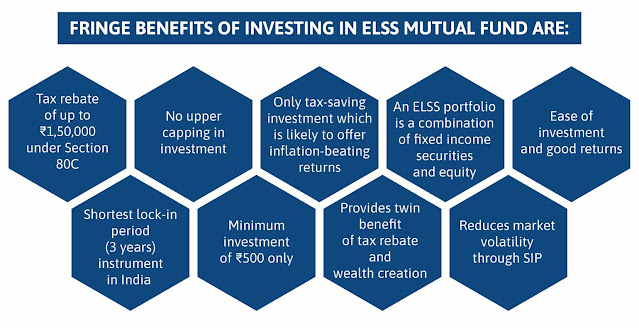
 ELSS MUTUAL FUND The ELSS (Equity-Linked Savings Scheme) of Mutual Funds is one of the best methods to generate wealth combined with tax benefits with the shortest lock-in period in India. The ELSS mutual fund is a tax-saving tool that enables you to save up to Rs. 46,800 annually and claim a tax credit of Rs. 1,50,000 each year under Section 80C of the Income Tax Act, 1961. SAVE TAX + BUILD WEALTH = ELSS Mode of investment in ELSS: SIP (Systematic Investment Plan) or Lumpsum? With a SIP, you can continue to contribute a little amount at regular intervals with the choice of investing weekly, monthly, quarterly, or biannually. SIP enables you to buy more units when the market is down and fewer units when the market is up, making it easier to profit from purchasing fund units during market cycles. When the market rises, SIP offers more financial gains upon redemption than the Lumpsum style of investment. Thus, investing in a lump sum is not advised to lower risk. Why recommend inves...

How to select the best Mutual Fund Scheme in India?

Image
There are 190 Mutual Fund houses that have over 7000 schemes. This can be very confusing for retail investors. Before investing, we should be aware what are the goals of our investment. The goals can be. Capital Appreciation Retirement Planning Children’s Education Tax Planning One more factor to be aware of is the tenure of Investment. Are you looking for a short-term investment Say 1 to 3 years or a long-term investment (5 years and more). For selecting a Mutual Fund, you should look for these factors: 1. Investment Objective of the Fund: Whether the fund is debt or equity-oriented, large-cap, mid-cap, or small-cap. If it is a diversified fund, then how is the spread. What needs to be noted is that the objective is matching with your own. 2. Type of Fund: a)Open Ended Funds: These are continuously available for repurchase and subscription. b)Close-ended Funds: These funds have a stipulated maturity date. c)Growth Fund: Growth is accumulated, and payments are made only at the end. d)D...